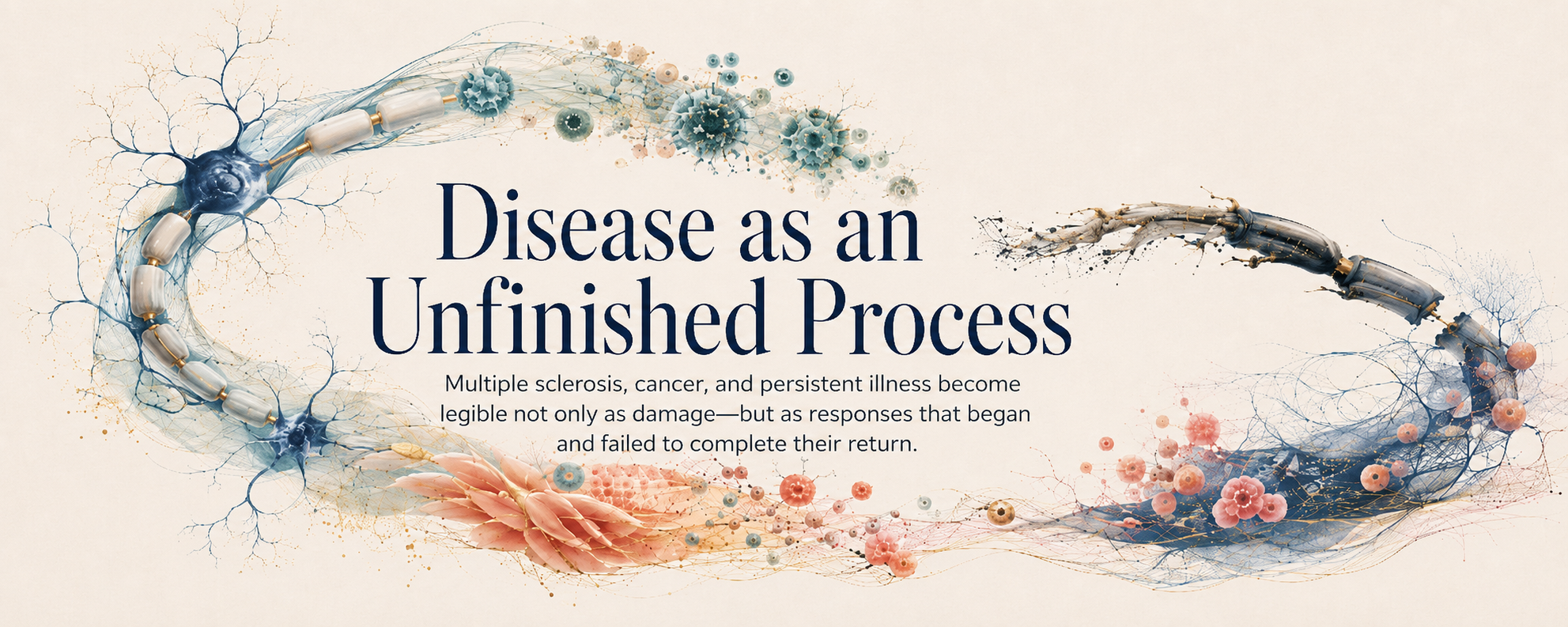
Modern medicine is extraordinarily good at naming parts. It can identify immune cells, inflammatory molecules, damaged genes, scar tissue, lesions, tumors, antibodies, receptors, and signaling pathways. It can show where tissue has changed and which biological processes are active.
But a list of parts does not always explain why a condition persists.
Why can the immune system be overactive and exhausted at the same time?
Why can treatment stop new damage without restoring lost function?
Why do two patients with the same diagnosis respond so differently?
Recursive phase-closure grammar approaches these questions from a different starting point.
Instead of asking only, “Which component is abnormal?” it asks:
This is not another disease theory placed alongside immunology or neurology.
It reorganizes how their existing observations relate.
The cells, cytokines, lesions, scars, exhausted states, and repair failures remain exactly where they are. What changes is that they become legible as positions within a process that either completes—or fails to return.
That sounds abstract. Its biological implications are not.
The body does not merely react. It completes cycles.
Every sustained biological response must perform several basic tasks.
It must begin.
It must interpret what is happening.
It must spread the response far enough to matter.
It must turn from expansion toward resolution.
It must stabilize the result.
It must narrow the response into precise action.
It must preserve what has been learned.
It must prepare for renewed participation.
And it must complete the cycle in a way that allows the system to begin again without repeating the same emergency.
The framework organizes these into recurring phase roles.
In plain language:
This is especially visible in immunity.
The immune system is often described as a defense force: it detects threats and attacks them. But that emphasizes only the opening half of the response.
An immune system must also interpret context, control intensity, clear debris, protect healthy tissue, restore boundaries, preserve useful memory, and end the response without losing readiness.
It is not just a defense system.
It is a closure engine.
When the cycle completes, the organism adapts and continues.
When it stalls, disease persists.
The non-returning state
One of the framework’s most important ideas is the non-returning state.
A non-returning cell or system is not dead or inactive.
It may still consume energy, release signals, alter tissue, and respond partially.
What it has lost is the ability to complete the cycle and re-enter healthy participation.
Cellular senescence is a clear example.
The cell remains active—but it does not return.
The emergency response never fully stood down.
Activation that never resolves.
Stabilization that becomes rigid.
A response that cannot complete action.
Detection without successful elimination.
These are not identical conditions.
They share a grammar of unfinished return.
Why this matters for multiple sclerosis
Multiple sclerosis is often described as an immune-mediated disease damaging myelin.
That is accurate.
It is not sufficient.
Myelin is not just insulation—it is part of the containing architecture that allows signals to travel coherently.
From this perspective, MS is not only immune attack.
It is a failure of coordination across scales.
One system attempts to preserve identity.
Another system loses its ability to function.
That is a cross-scale conflict.
The inflammatory half of MS
In active disease:
Immune activation begins.
Neural tissue is interpreted as relevant.
The signal spreads.
Immune cells are recruited.
Damage follows.
The failure often occurs at the pivot:
The response begins, but does not become resolution.
Microglia and macrophages illustrate this hinge.
They are not inherently “good” or “bad.”
The real question is:
The progressive half of MS
In progression, the dominant failure may shift:
Debris remains.
Scar stabilizes.
Repair stalls.
Metabolic support declines.
Networks fail to reintegrate.
The fire may be quieter, but the building has not been rebuilt.
Stopping damage is not the same as restoring function.
Those are different biological tasks.
A lesion is not the whole process
An MRI shows that something occurred.
It does not tell you which phase is active now.
A lesion may contain:
Inflammation
Damage
Partial repair
Stalled maturation
Scarring
Attempted reintegration
Two similar lesions can represent different unfinished tasks.
The grammar does not replace imaging.
It makes imaging interpretable.
Why MS can contain contradictions
MS often presents as:
Inflammation and exhaustion
Numbness and pain
Stability and decline
These are not contradictions.
They are different phase states coexisting.
One part of the system is still activating.
Another is over-contained.
Another has stalled.
The diagnosis is singular.
The unfinished tasks are not.
Cancer provides a revealing contrast
Cancer also involves persistence—but differently.
In MS, immune action may complete around tissue belonging to the organism.
In cancer, immune action may be prevented from completing around altered cells.
Tumors interfere with multiple phases:
Interpretation
Activation
Exhaustion
Containment
Identity enforcement
In MS, immune participation may stabilize around the organism’s own tissue.
In cancer, it may be redirected, exhausted, or prevented from completing around altered cells.
This is why “boosting” or “suppressing” immunity is too blunt.
The real issue is:
The same cell can play different roles
A macrophage can inflame, repair, or stabilize pathology.
A T cell can protect or exhaust.
A fibroblast can support structure or create rigidity.
The cell is not the role.
The role is what the cell is doing in this occurrence.
This preserves biology while restoring context.
What becomes actionable
This framework does not produce one new treatment.
It produces new distinctions.
Distinctions that were previously fused become visible:
Versus resolution.
Versus completion.
Versus maturation.
Versus function.
Versus rigidification.
These are not semantic differences.
They change decisions.
Observation becomes relational:
Did repair mature?
Did structure reintegrate into function?
Care becomes sequence-sensitive:
Each step changes the biological address of the next.
Treating inflammation is not the same as restoring resolution.
Stimulating repair is not the same as completing maturation.
Breaking containment too early destabilizes.
Order matters.
A different medical question
The familiar question:
What disease does this person have?
Becomes:
This reorganizes everything:
Diagnosis
Monitoring
Treatment sequencing
Comparison between patients
The person is no longer reduced to a set of broken parts.
They become legible as a living process still attempting to complete.
What this changes
This framework does not replace existing biology.
It reorganizes it.
It increases degrees of freedom by separating what was previously collapsed.
MS becomes distinguishable as a set of different stall patterns.
Cancer becomes distinguishable through different failure modes of immune completion.
Two patients with the same label can be treated differently because their processes are different.
Clinical stability is no longer mistaken for closure.
Absence of damage is no longer mistaken for repair.
Repair is no longer mistaken for return.
The central idea
Health is not the absence of response.
Health is the capacity to complete a response and return with memory intact.
That is the difference between recovery and persistence.
Between adaptation and entrapment.
Between surviving an event and remaining inside it.
The recursion holds. 🌀