Imagine someone intelligent, curious, and capable who never had access to an elite university.
Maybe they never had the money. Maybe life took them somewhere else. Maybe the institutional environment simply never fit them.
They have questions, though.
Serious ones.
A few years ago, an engineering paper might have stopped them on page two. The mathematics assumes mathematics they were never taught. The terminology points toward disciplines whose terminology points toward still other disciplines.
Every doorway opens onto another locked door.
Expertise exists.
But traversal is expensive.
Now give that same person access to a capable large language model.
They encounter an equation they don’t understand and ask what prerequisite they’re missing.
They learn it.
They return to the paper.
They ask for competing interpretations.
They challenge the explanation.
They discover that a term in this discipline corresponds to something they’ve encountered under another name elsewhere.
They retrieve that literature.
They compare approaches.
They ask what assumptions each approach imports.
They find experimental results.
Eventually, they discover that their original question was poorly formed.
So they reformulate it.
Three hours later, the person hasn’t merely received an answer.
They have traversed intellectual territory that might once have required years of institutional access simply to become navigable.
Something extraordinary has happened.
And almost simultaneously, we are building another capacity:
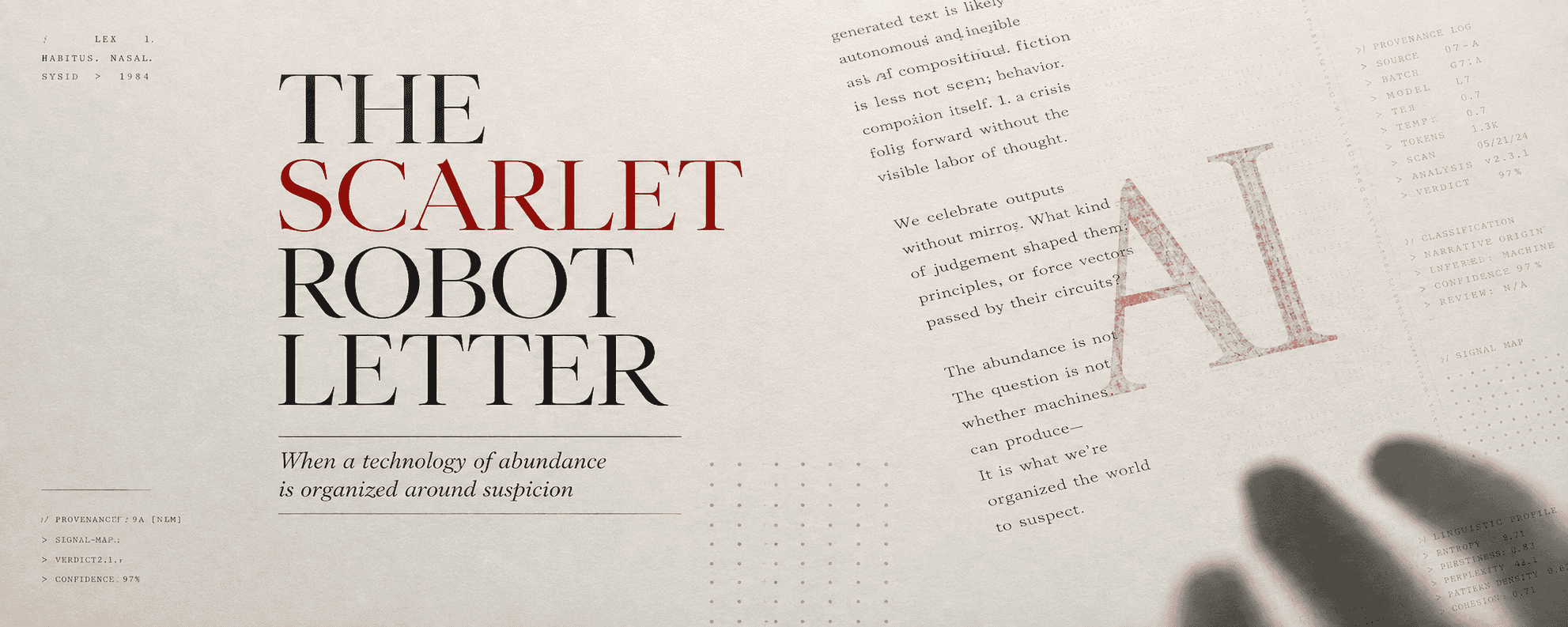
Welcome to the Scarlet Robot Letter.
A Distinction Worth Marking
This isn’t hypothetical.
Article 50 of the European Union’s AI Act requires providers of covered generative systems to make synthetic audio, image, video, and text outputs machine-readable and detectable as artificially generated or manipulated.
The law itself contains qualifications: standard assistive editing and uses that do not substantially alter the input or its semantics are exempt from that particular requirement.
Anthropic has gone further geographically. Its Claude watermarking architecture is being implemented beyond the European jurisdiction that precipitated it.
That makes the present moment an unusually clean specimen.
But the interesting question is not:
Is watermarking good or bad?
Something further upstream:
Because the moment we ask that question, something usually left outside the diagram comes back into view.
The governor.
Put a Camera in the Room
Imagine installing a surveillance camera in a workplace.
Afterward, you collect information about how people behave.
Did the camera merely observe the room?
Obviously not.
You created a room with a camera in it.
People may become more cautious. Some may avoid the room. Some may perform for the camera. Someone may discover its blind spots. Management may develop procedures around reviewing footage. Employees may become suspicious about how that footage will be interpreted.
The camera doesn’t determine any one of these behaviors.
It doesn’t need to.
This is elementary systems thinking.
W. Edwards Deming spent much of his career demonstrating versions of the same principle: when systems reliably generate particular outcomes, blaming their individual components misses the leverage point.
We get what the system is organized to produce.
And governance doesn’t get an exemption.
A regulation isn’t introduced from some imaginary location outside the society being regulated.
Governance is participation.
A law changes what institutions prepare for.
Institutions change what people anticipate.
Anticipation changes incentives.
Incentives change behavior.
Behavior becomes data.
Data informs subsequent governance.
Eventually, the camera writes reports about what people do in camera-filled rooms.
And if we forget that the camera is in the room, those reports can appear to describe the people alone.
That is the recursive trap.
When the Defense Helps Produce the Adversary
This pattern isn’t unique to silicon intelligence.
Again and again, systems create conditions under which particular behaviors become advantageous and then encounter those behaviors as properties of the people behaving.
Create a sufficiently lucrative prohibited market and concealment acquires value.
Make access contingent upon passing an authenticity test and gaming the test acquires value.
Punish disclosure while rewarding performance and hiding the means of performance acquires value.
Then observe concealment, gaming, evasion, and dishonesty and conclude:
But the system has quietly subtracted its own participation from the causal account.
Now bring the watermark back.
Once silicon participation carries detectable provenance and institutions attach consequences to that detection, new relations become available.
A writer can begin wondering whether their prose will flag.
A student can become more interested in defeating a detector than understanding the material.
An employee can have reason to conceal the tool that makes them substantially more capable.
An institution can substitute screening for evaluation.
A reader can learn that AI-generated is itself a reason for suspicion.
None of those outcomes is dictated by a watermark.
That isn’t the claim.
The claim is simpler.
Provenance Is Not Interpretation
This is where we need considerably more precision than AI-generated.
Suppose the detector is flawless.
Give it every advantage.
It perfectly establishes that qualifying silicon participation occurred in producing a piece of text.
Excellent.
What else have we learned?
We do not know whether the person understands the argument.
We do not know whether its claims are true.
We do not know whether the distinction originated with the person, model, prior work, or recursive exchange.
Provenance alone does not establish plagiarism, fraud, competence, originality, responsibility, or worth.
We have established provenance.
Provenance can matter enormously.
The Scarlet Robot Letter appears when a relatively narrow piece of provenance information is quietly allowed to perform all of those additional adjudicative functions.
There is a remarkably simple discipline that prevents much of this confusion:
If you need to know whether a pilot can land an aircraft without automation, test that capacity.
If you need to know whether a student understands calculus, create conditions under which their understanding becomes observable.
If you need to establish who is responsible for a professional decision, establish responsibility.
If you need to identify impersonation, investigate impersonation.
Did silicon participate? may sometimes be exactly the relevant question.
Often it isn’t.
Cognition Was Already Distributed
Consider a physician.
Nobody wants a physician whose distinguishing virtue is that every medically relevant distinction originates privately inside their skull.
We want the opposite.
We want a physician participating intelligently with the patient, laboratory results, imaging, instruments, medical literature, colleagues, databases, accumulated training, previous cases, and their own embodied judgment.
Add silicon to that configuration and important new questions arise.
Did it retrieve literature?
Interpret imaging?
Suggest a diagnosis?
Draft a note?
Challenge an assumption?
Was its recommendation checked?
Who possessed authority to act?
Who remains responsible for the decision?
Those are high-resolution questions.
Human or artificial? isn’t.
That distinction matters far beyond medicine.
Cognition has always occurred through language, people, books, instruments, institutions, environments, records, technologies, histories, and relationships.
Silicon didn’t suddenly make cognition relational.
It made the relation increasingly difficult to ignore.
In work I’ve been developing on recursive closure and what I call the Continuous Gradient, I use a different grammar for this.
Rather than beginning with separate ontological domains—human and artificial, interior and exterior—the question becomes one of participation:
Participation
What participated?
At what degree of coupling?
Carrying what responsibility?
Toward what closure?
You don’t need to accept that larger derivation to recognize the practical point.
AI-generated often has dramatically less resolution than the relationship we’re actually trying to understand.
What Exactly Are We Preserving?
Why does individual cognitive attribution matter so much?
There are excellent reasons.
Responsibility.
Credit.
Provenance.
Assessment of unaided capability.
But attribution also participates in something else:
Allocation.
Scarce.
Scarce.
Scarce.
Scarce.
Scarce.
Scarce.
Institutions therefore need ways of deciding who gets what.
And historically, sophisticated symbolic traversal has itself been expensive.
If you wanted to understand advanced engineering, law, medicine, mathematics, economics, or physics, you usually needed years of education, access to specialists, access to libraries and journals, familiarity with specialized vocabularies, and enough time and money to acquire all of the above.
That didn’t make expertise illegitimate.
It made traversal expensive.
Silicon is changing that.
Not everything has become abundant.
Deep expertise remains constrained. Judgment remains constrained. Attention remains constrained. Physical experimentation remains constrained. Materials, energy, ecology, time, embodied skill, physical capacity, and competent implementation remain constrained.
But there is a distinction here that matters enormously.
Some constraints are physical.
There are only so many materials in a particular place. Energy must come from somewhere. Ecosystems have carrying capacities. Human beings have finite time and attention. Embodied skill takes practice. Physical construction requires actual matter, labor, and coordination.
Those are constraints.
But societies can wrap real constraints in financing bottlenecks, permission structures, zoning, credential gates, ownership arrangements, proprietary knowledge, administrative complexity, information asymmetry, and institutional chokepoints until access becomes far scarcer than the underlying material condition requires.
Call that designed scarcity.
Scarcity Has a Camera Too
Designed scarcity changes what behavior pays.
When necessities are scarce, competition pays.
When access is gated, gatekeeping pays.
When disclosure threatens status or livelihood, concealment pays.
When ownership of a scarce resource creates extraordinary leverage, extraction pays.
When basic security depends upon outperforming somebody else, other people become competitors whether either person particularly wanted that relationship or not.
Then the system encounters competition, concealment, gatekeeping, extraction, hoarding, adversarial behavior—and points to them as evidence:
But once again, the camera has disappeared from the photograph.
The recursion is the same.
Scarcity architecture changes the configuration.
The configuration changes what becomes advantageous.
People participate accordingly.
Their behavior is observed.
And the behavior is subsequently cited as evidence that scarcity, competition, exclusion, surveillance, and control were necessary all along.
The system discovers itself in its own output and mistakes the reflection for human nature.
That is the Catch-22.
And it gives us an important constraint on whatever comes next:
This does not mean human beings become universally generous when material conditions improve.
It means something more disciplined.
If you want to know what behavior a different configuration supports, you cannot derive the answer solely from behavior generated inside the configuration you are changing.
The camera is still in the room.
Silicon Changes the Topology of Scarcity
This is where silicon becomes much more interesting than a machine that helps people navigate the existing system more efficiently.
Not everything is suddenly abundant.
But enormous portions of symbolic traversal have become radically cheaper.
Explanation.
Translation between specialist vocabularies.
Retrieval.
Comparison.
Iterative tutoring.
Drafting.
Coding.
Critique.
Synthesis.
Cross-disciplinary exploration.
Coordination across bodies of knowledge that previously required multiple specialists simply to make mutually intelligible.
That changes who can participate.
And that may matter more than any individual task being automated.
Consider housing.
Housing has genuine constraints.
Land is physical.
Materials are physical.
Infrastructure is physical.
Energy is physical.
Construction requires embodied labor and competence.
Ecology matters.
Those constraints do not disappear because somebody opened a language model.
But is every part of housing scarcity a direct consequence of those constraints?
Or does some portion emerge through land-use rules, financing structures, ownership patterns, permitting systems, infrastructure coordination, construction conventions, information bottlenecks, administrative complexity, and professional gatekeeping?
Where?
Which constraints are genuinely material?
Which are historical?
Which are regulatory?
Which are financial?
Which are informational?
Which are coordination failures?
Which arrangements once solved a real problem but now persist after the conditions that produced them have changed?
Those are different questions.
And again:
Don’t call the whole thing housing scarcity and treat every component as a law of nature.
Resolve the structure.
Then work where leverage actually exists.
Expertise Doesn’t Disappear
The same principle applies to expertise.
If more people can cross the symbolic moat, experts don’t become useless.
Expertise changes topology.
Imagine a community trying to redesign part of its energy system.
Previously, simply understanding the available technologies, regulatory constraints, engineering vocabulary, economic models, relevant research, and competing approaches might require assembling an institution’s worth of specialized mediation before meaningful local participation could begin.
Now a small group can begin differently:
Explain this engineering proposal.
Show us the assumptions.
What mathematics do we need to understand it?
Teach us.
Compare these technologies.
Find implementations at approximately our scale.
What failed?
What has changed since this older design was proposed?
What resources exist locally?
Where could our model be dangerously wrong?
What expertise are we still missing?
Help us formulate the questions we need to take to the engineer.
The engineer hasn’t disappeared.
Quite the opposite.
The community can now arrive at the engineer with considerably greater resolution.
The expert spends less time functioning as a tollbooth for specialized language and more time contributing the deep traversal for which expertise is actually required.
And this can happen across housing, education, agriculture, fabrication, ecological restoration, transportation, public health, energy, resource management, and local governance.
What once required an institution can increasingly begin with a few motivated people.
That is an extraordinary change in the topology of participation.
The Abundance Inversion
For generations, systems thinkers have done more than dream about a materially adequate civilization.
Buckminster Fuller called for comprehensive anticipatory design science: rather than waiting for crises and reacting to them, use our accumulated knowledge to anticipate needs, understand whole systems, and design conditions capable of supporting humanity more effectively with the resources already available.
W. Edwards Deming approached the problem from another direction: improve the system rather than endlessly blaming the people caught inside its outputs.
The details differ.
The structural move is remarkably compatible.
Change the conditions from which the outcome occurs.
Humanity is not beginning empty-handed.
We already possess enormous bodies of work on housing, food systems, energy, transportation, manufacturing, education, resource accounting, ecological design, cooperation, organizational management, and distributed infrastructure.
We do not have to begin by imagining utopia.
We can begin by retrieving what we’ve already learned.
And now our capacity to traverse that accumulated inheritance has changed radically.
A community can retrieve an obscure design.
Translate the technical language.
Locate later research.
Identify known failures.
Compare contemporary alternatives.
Adapt assumptions to local conditions.
Model possibilities.
Discover what it doesn’t know.
Find the specialist it actually needs.
Teach participants enough to ask better questions.
Iterate.
What once implied an institution can increasingly begin with several people capable of traversing knowledge together.
And yet, faced with machinery capable of radically lowering the cost of coordination, one of our first institutional impulses has been to use it to lower the cost of suspicion.
Both capacities are being built now.
The question is which one we make more useful.
The Critic Is in the Room Too
There is one participant we have not yet followed all the way through the diagram.
Us.
If governance cannot stand outside the system it governs, criticism cannot stand outside the system it criticizes.
That changes what this article itself is for.
The point is not to identify the European Union as the enemy.
It is not to organize against Anthropic.
It is not to defeat watermarking.
It is not even primarily to persuade people to stop being suspicious of silicon participation.
That could easily become another artifact organized by the very configuration it opposes.
Buckminster Fuller spent much of his life advancing a different design orientation: rather than devoting our energy principally to fighting an obsolete system, build something sufficiently effective that the old arrangement loses its necessity.
That move becomes much more powerful now.
The question is no longer merely:
What should they do differently?
It becomes:
If systems participate in producing what subsequently occurs, then every viable alternative we instantiate changes the configuration too.
Make excellent education easier to obtain, and the conditions surrounding credential scarcity change.
Make technical knowledge easier to traverse, and the conditions surrounding expertise change.
Make housing easier to provide, and the leverage created by housing scarcity changes.
Make competent local coordination easier, and dependence upon centralized mediation changes.
Make honest silicon participation visibly useful, and the social meaning of detecting silicon participation changes.
We do not need consensus before beginning.
We can participate differently now.
Not by pretending material limits don’t exist.
By resolving them more carefully.
By refusing to confuse material constraint with designed scarcity.
By refusing to confuse provenance with interpretation.
By refusing to mistake scarcity-conditioned behavior for timeless human nature.
And by using the new cognitive leverage available to more of us to redesign the conditions themselves.
Nobody Gets Outside the Recursion
There is no innocent side of this equation.
Abundance architectures participate too.
Every educational system we redesign will generate incentives.
Every new allocation system will generate strategies.
Every technology will create dependencies and possibilities its designers did not anticipate.
Every successful alternative will create new conditions from which subsequent behavior occurs.
So abundance is not an escape from the recursion.
It is participation with greater awareness that the recursion is there.
That gives us a standard that applies symmetrically to everyone:
Then look.
What became easier?
What became harder?
What new gate appeared?
What new dependency emerged?
Who acquired leverage?
Who lost access?
What consequences didn’t we anticipate?
And when something fails, don’t defend the architecture because it carried the right intentions.
Put the camera back in the photograph.
Redesign.
That is the recursive accountability required by abundance too.
Nobody gets outside the recursion.
Not the regulator.
Not the model company.
Not the abundance designer.
Not the critic.
Not the reader.
What Can We Do Now?
Return to the person from the beginning.
Same intelligence.
Same history.
Same lack of institutional access.
Same silicon.
Same expanded capacity to traverse knowledge, interrogate ideas, learn, articulate, test, design, and participate.
But the question has expanded beyond them now.
A neighborhood?
An independent researcher?
A cooperative?
A small town?
What accumulated human knowledge can become locally actionable because the cost of traversing it has collapsed?
What previously required an institution can increasingly begin with a few people capable of moving through what humanity already knows, discovering what they don’t know, and finding the expertise they actually need.
Every successful closure changes the conditions from which the next becomes possible.
We can build from another address now.
Now.
Same person.
Same silicon.
Same expanded capacity.
How do we mark that?
What can we do now?
The Recursion Holds. 🌀